Get Involved
Your knowledge, experience and expertise can help students thrive. From supporting them as they decide to come to SCSU to mentoring them as they navigate their next career step.
Dan Kitrell has always been interested in telling stories.
“Growing up, I was fascinated by advertising,” he said. “I was one of those kids who had a cassette tape recorder, and I would record advertising off the TV and the radio. So I knew going into college, that's what I wanted to do.”
He enrolled in St. Cloud State University intent on pursuing a degree in marketing. But once Kitrell got to campus, other opportunities presented themselves.
“I had Dr. Judith Litterst for speech, which was the required communications class back then, and absolutely loved it,” Kitrell said. “I ended up getting a second major in speech communication with Dr. Litterst being my mentor.”
 Kitrell earned his degrees in marketing and speech communication from SCSU in 1984, before going on to work in sales for companies such as Procter & Gamble. He earned his Master of Business Administration and started working in consumer research and shopper insights, “building off the curiosity of understanding what motivates people.” The next phase of his career was based in competitive intelligence in the consumer product space, working with clients like General Mills and Target. This ultimately led him to working for an advertising research company.
“That allowed me to get back to my childhood, my fascination with advertising and doing research because of curiosity,” Kitrell said.
One he retired, Kitrell moved to Santa Fe, New Mexico, with his wife and daughter. Amidst the height of the COVID-19 pandemic, he started researching New Mexico history as a way to keep busy.
“It was a part of American history I wasn't that familiar with, having grown up in Minnesota, and I was just fascinated by it. Our daughter ended up graduating from Los Alamos High School, which was one of the sites for the Manhattan Project,” he said. “So while we lived in Los Alamos, I went deep on learning about the Manhattan Project, and that became kind of an interest of mine. I was able to convert that into a volunteer opportunity working as a docent with the New Mexico History Museum.”
Kitrell initially led tours for the museum based on the overall history of the state. A daily tour he offered was a historic downtown Santa Fe tour.
“I described that as being two hours, two miles and 23,000 years. It was pretty broad coverage of New Mexico history, starting with the Ice Age footprints they found in White Sands National Park in New Mexico, dated back 23,000 years all the way to today,” he said. “As part of that tour, we'd always take our guests to some of the sites connected with the Manhattan Project that are located in Santa Fe, probably most notably the offices located at 109 East Palace, which were the offices for the Manhattan Project — where all of the civilians would check in prior to being transferred up to Los Alamos.”
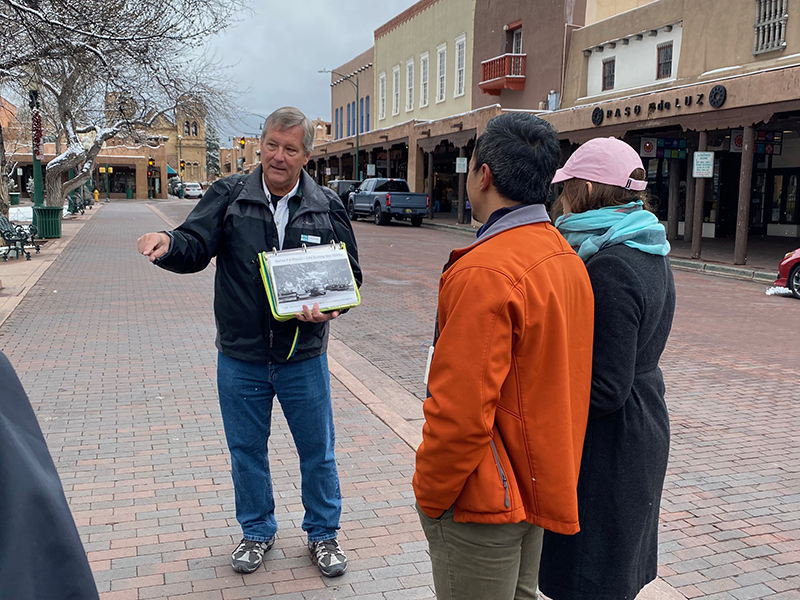
The museum hosted a business group looking to learn more about “the best teams ever assembled,” and one of the teams selected was the group behind the Manhattan Project. Kitrell was asked to turn his five-minute talk into a 30-minute conversation. His Manhattan Project presentation was so well-received, and coincided with the release of the movie “Oppenheimer,” that Kitrell was then asked to turn the 30-minute presentation into a two-hour walking tour: “Assassins, Spies and the Manhattan Project.”
“Leading my ‘Assassins, Spies and the Manhattan Project’ tour enables me to introduce key scientists, spies and couriers while standing at locations where key events actually occurred,” Kitrell said. “Many guests are locals, including student groups, who were not aware of Santa Fe's connection to Soviet espionage.”
Volunteer work like what he provides for the museum is something Kitrell feels he first became involved with while at SCSU. While on campus he was a part of the Delta Sigma Phi fraternity, and through it supported organizations such as the March of Dimes and Big Brothers Big Sisters.
“I did a lot of volunteering through the fraternity and through the University. When I think back, I had an interest in advertising and that really emphasized storytelling. The classes I took as part of my speech communication major also emphasized listening and interpersonal and public speaking and storytelling,” Kitrell said. “When I boil down my career, research is helpful, but it's what you do with the data, how you tell the story, how you can make interpretations and describe opportunities that really made me effective in that role. The formal training and marketing and speech combined with a long career in research — which really emphasized being curious, but also provided a platform for storytelling — I think just naturally segued into becoming a docent with the New Mexico History Museum.”
Kitrell especially enjoys educating fellow New Mexico residents about their state’s role in historical events.
“I’m showing them locations they've walked by numerous times in their visits or while they've lived here, and they've never understood the connection that location has to Soviet espionage during World War II. One of the stops on the tour that I love is Zook's Pharmacy; it’s now the Häagen-Dazs ice cream store on the plaza in Santa Fe,” he said. “That was the base of operations for the planning of the assassination of Soviet leader Leon Trotsky in 1940, which occurred in Mexico City. Santa Fe has this long connection with Soviet espionage, and people go in there for ice cream. They never realize that's where the Trotsky assassination was planned.”
In addition to showing people the history behind the area, Kitrell particularly enjoys working with students.
“The thing I love about students is — I think most adults will always be polite and always give you positive appreciation, but students will really let you know if you're keeping their interest or not. They ask some of the most insightful questions,” he said. “In fact, one of the questions I was asked by a middle school group has become part of my tour. It's just fascinating leading engaged, knowledgeable, interested students around, because it's a whole different experience than when you have visitors or locals on the tour.”
Kitrell encouraged others to look for ways to volunteer and get involved with their communities, and to be open to new opportunities.
“Find opportunities to volunteer and be part of your community and really pursue the things that interest you. I have always been curious. I frequently will tag my posts with ABC: always be curious,” he said. “I just love that as a mantra. Keep learning, be a lifelong learner. And then find ways to share your passion with others.
“It's interesting when I look back on going to St. Cloud State, and across my 40-year career and what I'm doing now in retirement. It’s only when you look back in retrospect that you've realized you've kind of been on the same path. You probably went in with a plan, but what's really allowed me to be happy throughout my career and now into retirement is the fact that I went in with a plan, but I was open to unexpected opportunities. I've been very fortunate to have great mentors and great teachers at St. Cloud State, great mentors in my career, and a great group I work with now at the New Mexico History Museum to really allow me to continue to do something in retirement that I enjoy.”
Your knowledge, experience and expertise can help students thrive. From supporting them as they decide to come to SCSU to mentoring them as they navigate their next career step.
Keep up-to-date with the latest news and research from the University, connect with local alumni and attend events, workshops and seminars.
Whether you are making a difference in your community, bringing about change to your industry or shaping the lives of those around you. We want to hear from you.