Get Involved
Your knowledge, experience and expertise can help students thrive. From supporting them as they decide to come to SCSU to mentoring them as they navigate their next career step.
Dr. Elizabeth Enninga believes that the right amount of passion and determination can change the world.
The St. Cloud State University alumna knew she wanted to study science from a young age, and found she was able to explore the sciences while at SCSU.
“I really enjoyed being at St. Cloud State because they gave me a lot of opportunities to get to see chemistry and physics and biology and figure out what was the most interesting to me,” she said.
A first-generation college student, Enninga also appreciated the University’s support system as well as its affordability. At the top of her list of SCSU highlights was working on master’s level research projects as a freshman.
“I got to do science right away as a freshman and that really incorporated my interest and love for the sciences in a way that was really productive and really helpful,” she said.
Enninga earned her degree in biotechnology with a minor in chemistry from SCSU in 2010. After getting over the “devastation” of not getting into graduate school, she went on to work with Epitopix, a company she previously interned with as a student working on veterinary vaccines. Enninga was then hired as a research technologist with Mayo Clinic, working in a lab focused on melanoma research. Her mentors in that position encouraged her to reapply to grad school, which she ended up attending through Mayo Clinic with an emphasis on clinical and translational science.
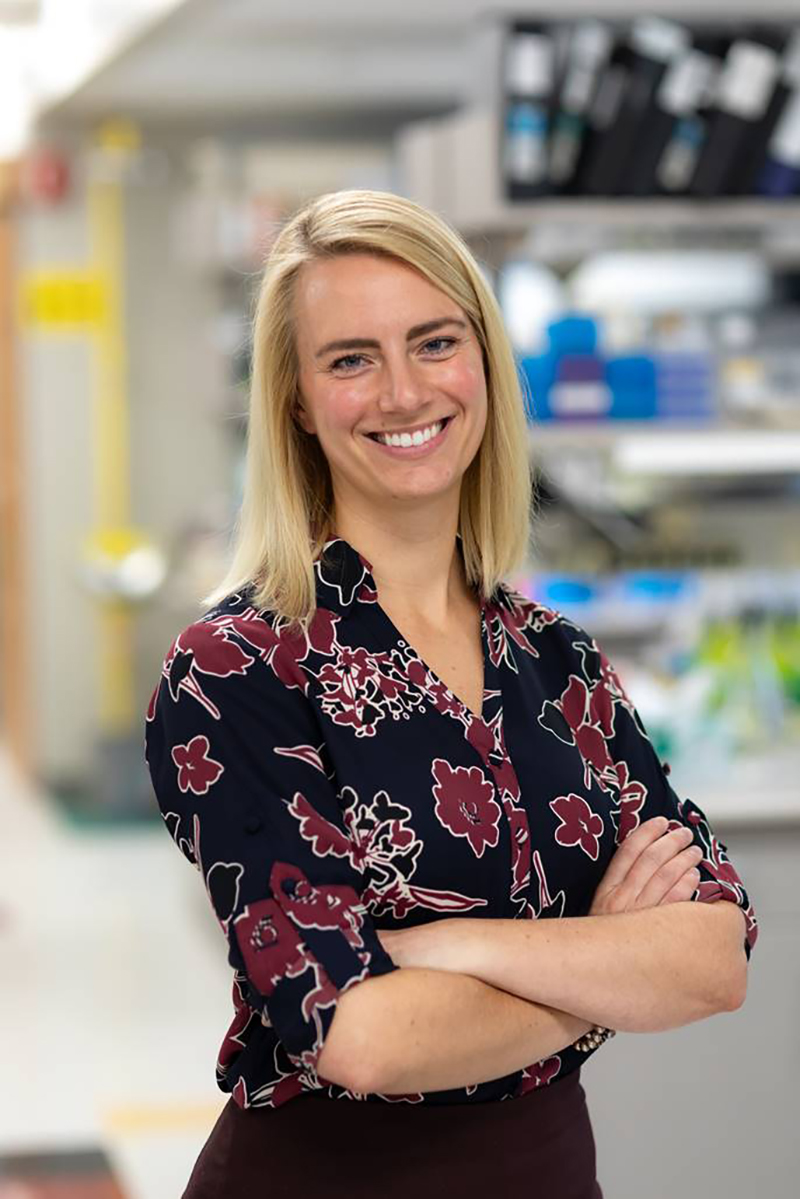 “I like to say that I'm an applied immunologist because I really like to try and understand disease from the context of not only what's happening during whatever condition you're studying, but how do you actually take that information and build a better diagnostic test, or build a better treatment or preventative measure in order to impact human health,” Enninga said. “I was studying the similarities between tumors and trophoblast cells of the placenta because they do a lot of similar things. I would say tumor cells do exactly everything that a trophoblast cell of the placenta does. The placenta just knows when to stop — at nine months it's done, whereas tumors just keep going. So I was studying these different mechanisms and really kind of falling more in love with the reproductive field.”
After earning her PhD in 2016, she completed additional post-doctoral training in the reproductive field. In 2020 she became a faculty member with Mayo Clinic, where she is now an assistant professor with Mayo Clinic College of Medicine and Science and an associate consultant in the Department of Obstetrics and Gynecology, Immunology. Enninga’s research lab focuses on how the immune system changes during pregnancy to support both mothers and infants. The topic has quickly become a passion project for her.
“Women's health in general has just been lagging behind. I mean, the fact that it's 2025, almost 2026, and we still don't actually know what causes spontaneous labor is kind of sad to me. There are a lot of women who have many complications during pregnancy and there are no treatments, there are no strategies for dealing with a lot of these things,” she said. “We can maybe diagnose it, and our treatment for many different pregnancy complications is deliver the baby. Well, if you're 22 weeks pregnant and you have a complication and the only option is deliver the baby — that means you're going home without a baby. So there's a lot of gaps in that field that, to me, need to be filled by somebody who’s very passionate about trying to make a difference.
“I'm going to try and work on questions related to things that impact young women that can change the trajectory of their life. If you have certain complications in pregnancy, you're at much higher risks of more issues and problems, cardiovascular and metabolic problems later on in life. There's just so much unknown about this timeframe in women's lives that I just felt I could make a difference.”
There are two major statistics that Enninga desperately wants to work to change.
“I want to have less maternal mortality. Nine-hundred women in the United States die every year due to childbirth. That's unacceptable. Thousands of babies die every year. There's so many things we could just do better in this area,” she said. “My research is really focused on, yes, understanding what's happening biologically, but also trying to see where biologically we could target to actually have a positive impact. That might be earlier diagnosis, that might be treatments for certain conditions during pregnancy that we have no treatments for — but different things we can actually do that would impact pregnancy in one way or the other for the better.”
Currently, Enninga’s research is examining fetal growth restriction and learning more information from the placenta.
“There's a whole bunch of information we can gain from the placenta if we take the time to look at it. We're looking at placentas right now from both women who are having full-term healthy pregnancies and then women who are having growth-restricted pregnancies to try and understand what is it about that placenta that changed and was altered to cause this baby not to get the nutrients and oxygen it needed to grow optimally,” she said. “A lot of what my work is doing right now and what I hope it will do in the future is incorporating more of the interactions between pathology, between obstetrics and neonatology pediatrics so that we can really, truly use that placenta to give us a really good snapshot into what are the challenges both mom and baby may face in the future — whether it's a future pregnancy, whether it's more hospitalizations, diagnoses of neurodevelopmental disorders; all of these things have some connection to the placenta. We need to take that information that we're currently kind of ignoring and utilize it in a way that will improve health.”
Enninga encourages her students as well as others in the field to understand that not every experiment or project will be successful, but to always keep going.
“I tell all my current students, ‘You're going to fail probably 80, maybe 90 percent of the time before things are actually going to start working. You have to get that feel of what it's like to keep going and persevere over all of that,’” she said. “I'm a big believer of you have to be able to care. Projects will come and go, but if you don't care about the project, it's not going to go anywhere. Find something you really love and keep going after that. And don't give up, because if I would have given up after not getting into graduate school, I definitely wouldn't be where I am today.
“I’m a pretty average person. I think that's something I always try and instill in the students I work with. You don't need to be this incredible rock star to be a good scientist. You just have to show up and do the work. Every day I try something. Some days it works, some days it doesn't. But I tried, right? And I think that's the key to success these days, is you just keep trying. And at some point, that trying will lead to enough new knowledge that you can figure out how to get it to work. It doesn't take a really brilliant mad scientist to do the kind of work that I'm doing. It's just somebody who cares and is willing to keep trying.”
Your knowledge, experience and expertise can help students thrive. From supporting them as they decide to come to SCSU to mentoring them as they navigate their next career step.
Keep up-to-date with the latest news and research from the University, connect with local alumni and attend events, workshops and seminars.
Whether you are making a difference in your community, bringing about change to your industry or shaping the lives of those around you. We want to hear from you.