Get Involved
Your knowledge, experience and expertise can help students thrive. From supporting them as they decide to come to SCSU to mentoring them as they navigate their next career step.
Dr. Ruthanne Soohee Kim believes in the power of education to solidify connection through communities.
Kim joined the Minnesota State Colleges and Universities system in 2020 as an academic equity strategy fellow before becoming a professor for the Community Anti-Racism Education (CARE) Initiative at St. Cloud State University. She has long been involved in the field of philosophy as it pertains to decoloniality, race, transnational feminism and beyond. As she initially started working through a number of those topics with students early on in her career, she realized a lot of conversations tied back to certain periods of history.
“A lot of what I was seeing were the processes and structures of both the Cold War and World War II in a new geopolitical climate and arrangements that have brought many people from all over the world to Minnesota. I began to become curious about what are the structures and intersecting lines of inquiry that I'd already been studying, which is really — what we call in philosophy — post-World War II existentialism and phenomenology,” she said. “A lot of these conversations were coming out of World War II at the height of what we had seen as the ultimate act of ethical betrayal: the Holocaust, the Shoah. Many philosophers were thinking about the end of humanity, the end of ethics, how can nationalism go awry? And these questions were often being completely ignored as having relevance to their colonial counterparts. Many of the same people who are espousing human rights, an end of the moral decryment of the behavior of the Nazis, were still perpetuating similar structures of violence.”
She noticed that societies with those similar structures seemed to have certain behaviors toward their overseas territories.
“I’m someone who's from overseas. I was born in South Korea. I'm a transnational, transracial adoptee. I began to realize in my research that there's a lot of confluences between people who are born of waters on the outskirts of colonial empires. My own story of being a South Korean immigrant is one where the Cold War specifically impacted my move to the United States. When I came here, when I came to Minnesota, I realized there are something like, I want to say — it's an astonishing number — maybe 60,000 Korean adoptees who are brought to Minnesota,” she said. “Suddenly I'm starting to realize my own diasporic story is entangled with the diaspora story of people from Somalia, people from the Hmong regions — northern areas of what we call Laos and Vietnam. Many of our stories are actually entangled within one another and affected by these same colonies and empires that I've been studying in my European training for philosophy.”
That brought Kim to an additional research trajectory, which looked at Caribbean philosophy while referencing a number of French surrealists, critical theorists, cultural theorists, philosophers and poets.
“I realized that my training in French philosophy that I'd done in my PhD had relevance in what we call the francophone world — the French-speaking world — of people who had experienced particularly African enslavement. And then from the Asian side, labor conditions of forced work labor and labor hiring that was done from the Asian and North African sides of empires to replace enslaved labor,” she said. “This allowed for there to be this really concentrated conversation about race and difference of religion.”
As she became an expert in these subjects, Kim started working on a book, “Forces of Creolization: Glissant with a Decolonial Feminist Aperture,” which will publish in spring 2026. She initially put the book together in the late 2010s, but the COVID-19 pandemic’s temporary shutdown of the publishing industry delayed its review process as well as its production and release.
“I began to realize this obviously had a large exchange in the current area that I was teaching in — at the time I was teaching at Minneapolis College and an urban tier school in Minneapolis,” she said. “Even though we're far away from the island, many of the same forces of racialization — structures of police violence, of targeting people by class and class being coded by race — was very similar. So really drawing research with my students was a big part of my approach.”
When Kim joined the Minnesota State system in 2020, she started to review the system’s equity data and see the patterns and areas she wanted to help address. As her fellowship ended and as she completed her book, she saw the CARE position open up at SCSU and jumped at the opportunity.
“It was a unique position because it allowed me to remain a faculty member, but still contribute my administrative skills and strategic thinking to the role,” she said. “That allowed me to continue to be an educator, but a community educator as well as an academic educator.”
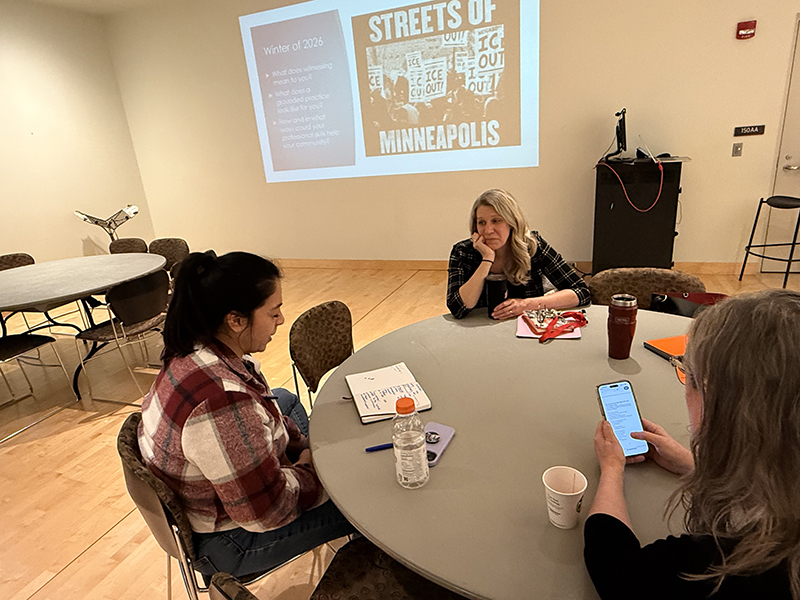 Kim splits her time between her SCSU position and her role as the equity faculty coordinator for Minnesota State. She is also an adjunct professor for different universities.
Through her work with CARE, Kim works in “acknowledging the community and affirming the community.” By partnering with different departments at St. Cloud State as well as different organizations in the St. Cloud community, CARE has been involved in art-centered workshops as well as artificial intelligence integration and training, among a number of other subjects.
“People have asked me, ‘Why are you doing AI?’ And it's because anti-racism is always interested in the most powerful structures of society, because that is where racism lives. And AI — an idea, innovation — is one of the most powerful structures that's shaping our work, who we are, how we do things, the kind of skills that we have or don't have, and the jobs that we have access to or don't have access to. I think having anti-racism at the table on this work has been really important, and I'm really pleased that my colleagues at SCSU also agree,” Kim said. “That has been a big part of the workload this year — is helping support grant applications so we can continue to get funding to do the amazing work our faculty do here on this campus collaborating with students. The AI work has been really exciting. We've had several faculty partner with students to really drive what that innovation looks like, and then to use student leadership and student research to be at the heart of what we're offering our students and our faculty in terms of professional development, as well as the community who's really interested in more AI training and understanding.”
CARE’s mission doesn’t necessarily mean starting all new projects or initiatives.
“I think CARE's role is to put eyes on the structures and the great things that are already happening,” Kim said. “We don't necessarily have to start anything new, but we have a capacity to align and to amplify and elevate the many communities, cultures and organizations, programs that already exist.”
SCSU’s CARE office also serves on a community advisory board called Create Community, which is an anti-racist community collaborative in St. Cloud that includes business partners and schools as well as nonprofit organizations. Both the missions of CARE as well as Create Community have been especially integral as current events unfold in 2026. Kim as well as SCSU Library Professor Melissa Prescott worked on a press release in February 2026 with St. Cloud Mayor Jake Anderson ’03.
“We (were) co-writing with the mayor a press release talking about the ongoing structures of racism that Operation Metro Surge continues to reverberate here in central Minnesota and what that means for the wider community. We cannot rely on local government because of how much they are bound to the federal government and FOIA laws to not in any way show that they are undermining the law, and obviously we're all here because we believe in law. So our press release is to talk and be able to show the power of the community and the neighborhood organizations and which ones people can turn to right now. Who are the vetted trusted organizations, using our word of mouth, our knowledge of the community to strengthen, to rebuff credibility attacks against both our Somali neighbors as well as our immigrant neighbors, and to show the strength of our united community,” Kim said. “The fact that if you want to know who to trust, we know who to trust. We actually have that network established. We've been doing anti-racism work for years in St. Cloud. The conversation on race is one of the oldest conversations that a city has been consistently having. This is where Create Community comes in. We're both a campus organization and we're a community-facing organization, and we really bring those two together to stabilize both the campus and the community in anti-racism efforts.”
In addition to domestic conflicts, world news such as the Israeli–Palestinian conflict affects many in #OurSCSU community.
“The October 2025 kidnapping and killing of Israelis happened, and that then erupted right into the ongoing reprisal attacks against Hamas and Palestine and the Gaza region that brutally ripped apart our community, where people on both sides — both Muslim and Jewish community members — both felt unsafe. That was probably, I'm going to say, one of the trickiest times to be in this role. So I worked with the Center for Holocaust and Genocide Studies, as well as our American Indian Studies — because genocide is not just a uniquely European experience, it's also an American experience — and then our ethnic studies professors and students to form a panel on how Minnesota regionally experiences many of the same tensions. We have legacies of enslavement here, we have legacies of American genocide, and we also have Jewish communities as well as Muslim neighbors all living here,” Kim said. “We formed a conversation. We didn't want to call it anything that would trigger people. And students were leading conversations on keeping Muslims safe on campus, and we didn't want to undermine their efforts. So we carefully crafted a program that we did at the public library called ‘What's in a Name?’ We invited everyone in the community on what did the term genocide mean? What is the history of genocide? What do these terms mean? And then we looked to the wider community and saw this is not just one conversation.”
SCSU and its ties to the greater St. Cloud community are part of what makes those conversations possible, according to Kim.
“St. Cloud State is so unique. We have an ability to bring together all of these groups. We have a long history of working with the College of St. Benedict. They're not our competitor; they're our partner. We have a long tradition of having a great partnership with St. Cloud Technical and Community College. We are an anchor institution for so many different community organizations, the Chamber of Commerce, local artists, right? You name it; there is a Husky alum somewhere in the group,” she said. “I find that St. Cloud State is really able to use our expertise to help the community organize. Many of the things that people need — they all have good ideas, but they just don't have the organizational capacity to launch, to lift something like this, or to speak to the nuances of this.”
The area’s diversity and community connections are what keep Kim in central Minnesota and working at SCSU.
“I would say what keeps me here in central Minnesota is that people here have been doing the work for decades. They've been moving here. This place has become quietly quite different than it was 30 years ago. We have Somali East Africans living here, and they wouldn't come here if it wasn't a desirable place. There is something very community driven, something very welcoming. There are wonderful pockets. One of my facilitators on the CARE team works at the Newman Center. I mean, we have a Catholic center for peace here in the region. We've got a vibrant Jewish community that's contributing. We have a growing Muslim population,” she said. “February this year was great for St. Cloud. We've got Lent, Mardi Gras, Ramadan and Lunar New Year all happening in the same place. And that's where St. Cloud can really shine. All of those community members are part of that community. St. Cloud State has a long history of providing both faculty, students and community with a gathering place to continue the work that people have been doing for decades. For over a hundred years, this university has a legacy of doing this work.”
Your knowledge, experience and expertise can help students thrive. From supporting them as they decide to come to SCSU to mentoring them as they navigate their next career step.
Keep up-to-date with the latest news and research from the University, connect with local alumni and attend events, workshops and seminars.
Whether you are making a difference in your community, bringing about change to your industry or shaping the lives of those around you. We want to hear from you.