Get Involved
Your knowledge, experience and expertise can help students thrive. From supporting them as they decide to come to SCSU to mentoring them as they navigate their next career step.
Creativity and imagination have always been central to Stacia Goodman’s life, from building things in the woods as a child to now making large-scale art installations as a professional artist.
Having grown up in an impoverished rural community in northern Minnesota, Goodman said she followed her older sister to St. Cloud State University as the first generation of their family to pursue higher education. While Goodman — then Stacia Fink — pursued a degree in mass communications, she took as many art classes as possible while on campus. She also worked part-time in the University Communications department, writing press releases, articles and even a president’s graduation speech.
“I grew up without any access to the arts at all, so when I got to St. Cloud State, I was like a sponge. I would look at bulletin boards — because there was no social media back then — and I would go to someone's trumpet recital, even if they were a stranger, or go to plays, or go see art on campus. I just had this insatiable sense of curiosity,” she said. “I felt like I really wanted to take ownership of my life and my education. SCSU helped me and exposed me to so many different things — from spring training with the football team to astronomy, to my journalism classes, to art classes, all of it. I'm really grateful.”
Goodman earned her degree in 1989, and upon graduating took a job in a public relations advertising agency. She worked there for a few years before leaving to be self-employed full time. She kept writing, but started taking art classes and continued to do so while starting a family with her husband.
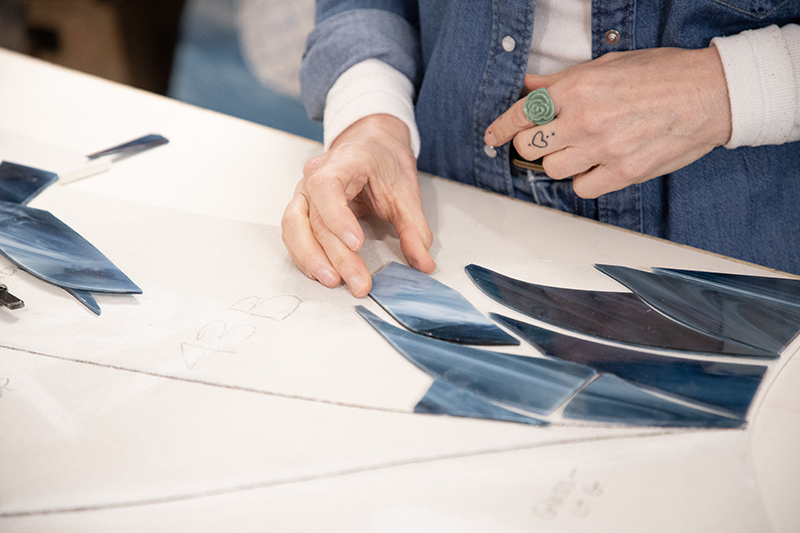 “I continued to nurture my artistic skills at night after I put the kids to bed. I took one sort of mosaic class from an artist. I had taken pottery classes and realized I liked the pottery part of it, but I did not like the making it, the glazing it — I just liked the pieces,” she said. “So I took this one mosaic class and I was really hooked. It was literally a two-hour class, and I still have the first thing that I made — which is atrocious, but I love it.”
Twenty years later, Goodman has traveled across the country from coast to coast producing mosaic works of art in public, professional and private spaces. Her first piece of public art was produced in 2008, when her children’s elementary school was approaching its 100th anniversary.
“I had the audacity to suggest for my first public art project to do a two-story huge mosaic tree made out of tile and all the stuff kids threw away at the end of the school year, because I was so bothered by the waste: pencils and crayons and wooden puzzle pieces; the teachers would toss out old mugs and medals from track and field day. I figured out a way to make it and worked with the art teacher there for the kids to make handmade leaves, that became the canopy, in art class,” she said. “I went from making very small artwork to just having this vision of doing a huge two-story piece. I just saw it. And to this day, that's still how I work. I usually just see what I think should be in a place. I don't know how else to describe it.
“It's been a gift because it's allowed me to really work outside any rules or boundaries with the imagery that I see, but then also the materials I use in my work.”
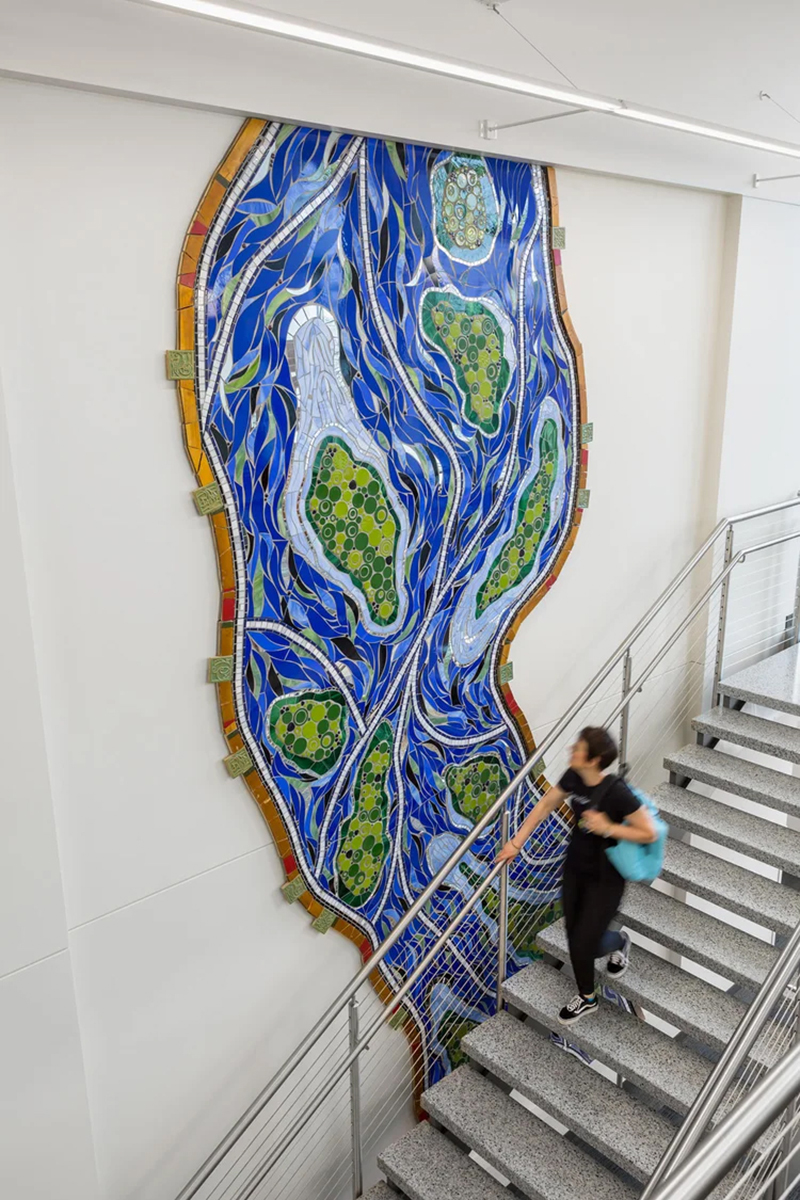
Goodman carries the practice of upcycling throughout all her artwork. She has produced two large-scale pieces for her alma mater, both of which can be found in SCSU’s Eastman Hall. The pieces are a culmination of ceramic tile, handmade tile, glass and mirror, but also pieces of wooden gym floor and swimming pool tile from Eastman Hall itself. For a piece installed at a tech company in January 2026, Goodman used old circuit boards to construct fish swimming through a river because she felt that resonated with connecting and technology.
While she has built out her portfolio through the years, Goodman has simultaneously continued to use her mass communications degree from St. Cloud State.
“For many years I've been a freelance marketing communications and public relations consultant and writer. I've scaled back that work as my artwork and career has really soared and I've had a certain amount of success, but I still enjoy being in the business world and writing. The through line between both careers is being a storyteller,” she said. “The motto for my public art practice is ‘capture the story of your space.’ I see myself as a natural storyteller. I'm either telling stories with the mosaic art that I'm doing — specifically the public art I'm doing, because I really have to get embedded in a community and listen to what their stories are, listen to what their trauma might be, what they're trying to heal, what they're trying to highlight, what they're trying to beautify, conflicts that may be part of their community historically or currently. But then also I'm telling stories in the marketing communications writing work that I'm doing. One just happens to be with words, the other happens to be with my hands.”
 Trying to be an artist full time is not for the faint of heart.
“How I got specifically from that first huge mosaic at my kids' elementary school to where I am now is literally tenacity, grit, surviving so many rejections, and just basically not giving up, and having a really supportive husband and family,” Goodman said. “I think about my artwork very much as a businessperson. I've had a lot of friends who are artists who have not been able to make it because they just want to do the creative part. And honestly, the creative part of it is probably half of what I do. On some days, some weeks, it can be none of what I do because I am marketing myself, promoting myself, ‘social media-ing’ myself, applying for projects… I put out a quarterly e-newsletter, so I'm writing that, aggregating photos, researching materials, things like that.”
Goodman encouraged others looking to pursue a career in the arts to think of the whole picture.
“One of the things I always encourage students to do if they are still in school is to not think myopically about just taking the creative classes. I tell them to take an accounting class, take a marketing class, take a business class, take a speech class, take a writing class. You're going to have to give presentations, you're going to have to defend your work. You are going to have to understand how to price your work. If you’re self-employed, you're going to have to understand how to run a small business. You're going to have to understand how to market it, how to keep your books straight. If you hire someone to help you, you have to understand the laws around that. If you're on a construction site, you have to understand OSHA safety,” she said. “I warn them, I don't discourage them, but I warn them how hard it's going to be, that they have to be tenacious. Don't go into it if you can't handle rejection — if you can't pick yourself up, dust yourself off, be passionate about what you do and keep going.”
As someone who grew up with absolutely zero access to the arts, Goodman’s mission is to change that for others. It’s also to amplify the voices of those often left marginalized.
“With my public art, what I'm most passionate about is making art accessible to everyone. I think that's also why I love putting found and upcycled objects into my work, because someone can look at it and say, ‘Is that a circuit board? Is that a hockey stick?’ I also like to include mirror in my artwork because I literally want people to see themselves in the artwork and become part of the art and take ownership of it. That is so important to me. Every piece of public art that I install in a public space, I feel like it's a little victory for my mission, for really cheering for the underdogs and the people who don't have privilege. I also want my art to beautify spaces. When I do artwork in health care, I hope it provides respite for people. It can provide beauty, it can provide humor, it can provide solidarity, it can validate people,” she said. “I'm a big advocate for the imagery in my work to be accurate in who is being represented. That's very important to me. I don't think you can be a public artist without being a social and racial justice activist. That's just my opinion, but if you want to be in the public artist space, capturing those stories and making sure they are authentic, accurate stories — you have to be involved in what your community is experiencing, and putting yourself on the front lines for the people who can't or who don't have that privilege.”
Your knowledge, experience and expertise can help students thrive. From supporting them as they decide to come to SCSU to mentoring them as they navigate their next career step.
Keep up-to-date with the latest news and research from the University, connect with local alumni and attend events, workshops and seminars.
Whether you are making a difference in your community, bringing about change to your industry or shaping the lives of those around you. We want to hear from you.